

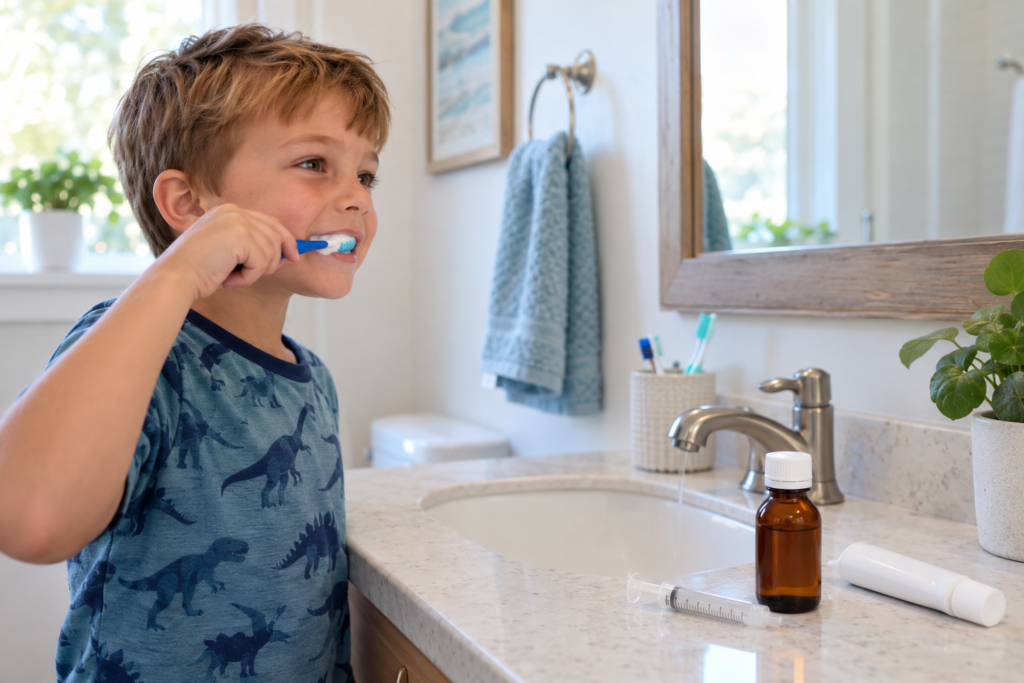
Medicines help children manage many short-term and chronic health needs. Many medicines do not directly damage tooth structure, but some drugs or formulations can change the environment inside a child’s mouth.
Understanding how medicines affect children’s teeth can help parents recognize changes worth discussing with the dental team. A medicine may reduce saliva, contain sugar or acid, leave residue in the mouth, or contribute to changes involving the gums and other oral tissues.
How often a child takes a medicine, when it is given, and how long treatment continues may also matter.
These effects are not a reason to stop a necessary medicine. Parents should continue to follow the prescribing clinician’s directions and involve the prescribing clinician, pharmacist, and pediatric dentist when questions arise.
Why the Form and Side Effects Matter
Two children taking medicines for different health needs may have very different dental risks.
The active drug is only part of the picture. The dentist may also consider:
- Whether the medicine is a liquid, chewable tablet, dissolving tablet, or inhaled treatment
- Whether the formulation contains fermentable sugar or is acidic
- How often the medicine contacts the teeth
- Whether the medicine reduces saliva or changes its thickness
- How long the child is expected to use it
- Whether the child’s medical condition makes brushing, eating, or dental visits more difficult
Diet, fluoride exposure, brushing habits, cavity risk, and other health needs also influence the overall plan.
A medicine should not automatically be blamed for a dental change without an evaluation.
Dry Mouth Can Reduce Natural Protection
Saliva does more than keep the mouth comfortable. It helps wash away food particles, supports swallowing, and supplies minerals that help protect teeth.
The National Institute of Dental and Craniofacial Research explains that persistent dry mouth can increase the risk of tooth decay and oral fungal infections.
Some prescription and over-the-counter medicines can reduce saliva. The effect can vary depending on the specific medicine, dose, hydration, and the child’s overall health.
Parents may notice:
- A sticky or unusually dry mouth
- Thick or stringy saliva
- Cracked lips
- Frequent thirst
- Difficulty chewing or swallowing dry foods
- Persistent bad breath
- Mouth soreness
- New areas of tooth decay
A child may not describe the problem as “dry mouth,” so changes in eating, drinking, speaking, or comfort may provide clues.
If the problem continues, tell the dentist and the prescribing clinician. Do not change the medication or dose independently.
Liquid and Chewable Medicines May Increase Tooth Exposure
Liquid medicines can be easier for young children to take.
Sweeteners and flavorings may be added to improve acceptance, while acids may be part of some formulations. However, products vary. Parents should not assume that every liquid medicine contains sugar or that every sugar-free medicine is nonacidic.
A 2025 review of pediatric liquid medications and dental caries found that sugar content, acidity, frequency, timing, and long-term use may influence dental risk. Evidence was not identical across every study because tooth decay involves several interacting factors.
Repeated exposure can also matter.
For example, a child taking a sweetened or acidic medicine several times a day over a long period may have different preventive needs than a child taking a medicine briefly.
Nighttime dosing may deserve additional attention because saliva flow naturally decreases during sleep.
Chewable vitamins, antacids, cough products, and other over-the-counter items should also be included when discussing medications with the dental team. A product being labeled “vitamin” or “natural” does not automatically mean it has no effect on the mouth.
Inhaled Medicines Can Affect the Mouth Too
Inhaled medicines do not contact the mouth in exactly the same way as syrups, but some medication may reach the teeth, tongue, palate, and throat.
Certain inhaled treatments may be associated with dryness, irritation, or oral yeast overgrowth.
Follow the prescribing clinician’s directions for inhaler technique, spacers, and mouth care.
If the medical team has instructed your child to rinse after using an inhaler, supervise the rinse and have the child spit when age-appropriate. Do not change how an inhaler is used because of a dental concern without speaking with the prescribing clinician.
Some Medicines May Affect the Gums, Tissues, or Tooth Color
Selected medicines can be associated with changes such as gum enlargement, tissue irritation, mouth sores, altered taste, fungal infection, or changes in tooth color.
The effect depends on the specific medicine and child.
Not every dark or discolored area on a tooth is caused by medication. Changes in appearance can also come from plaque, cavities, injury, enamel development, foods, or other causes.
A pediatric dentist can evaluate whether discoloration appears to be on the tooth surface, within the tooth, or related to decay.
Parents should avoid aggressive scrubbing or whitening products unless a dentist specifically recommends them for the child.
If you suspect a medication reaction, contact the child’s medical team. Lip or tongue swelling, difficulty breathing, or other signs of a severe allergic reaction require emergency medical attention.
Long-Term Medicines May Change a Child’s Preventive Needs
When a child takes medicine over a long period, the medication is only one part of the picture.
The underlying health condition may also affect diet, saliva, movement, home care, sensory tolerance, or the ability to attend routine dental appointments.
The effects of the illness and its treatment may therefore overlap.
For children with special healthcare needs, we can also adapt care according to the child’s health history, developmental needs, sensory needs, and comfort. Special needs dental care is an individualized service rather than something automatically required simply because a child takes long-term medication.
Coordination with pediatricians, specialists, pharmacists, or other members of the care team may be helpful when oral symptoms appear or dental treatment is being planned.
The goal is not to make the family’s routine more complicated than necessary. It is to identify the most meaningful risks and build realistic preventive care around the child’s medical needs.
Practical Ways to Protect Your Child’s Teeth
Parents can take several steps without interfering with prescribed treatment.
1. Keep an Updated Medication List
Include prescription medicines, inhalers, over-the-counter products, vitamins, supplements, and medicines used only as needed.
Bring the list to dental cleanings and exams and update the dental team when something changes.
2. Ask Before Changing the Formulation
A pharmacist or prescribing clinician can tell you whether an appropriate alternative formulation is available.
Do not substitute another product or change the dose without professional guidance.
3. Give Medicine Exactly as Directed
Use the dosing device supplied or recommended with the medicine.
Do not change the timing of a dose solely for dental reasons unless the prescribing clinician approves the change.
4. Use Water When Appropriate
If the medication instructions and the child’s medical needs allow it, plain water after a dose may help clear residue from the mouth.
Young children who cannot rinse and spit need age-appropriate guidance.
5. Protect the Bedtime Brushing Routine
Children should brush twice daily with an age-appropriate amount of fluoride toothpaste.
If a medicine must be given after bedtime brushing, ask the pharmacist and pediatric dentist how to manage the mouth afterward without interfering with the medicine’s instructions.
6. Watch for Signs of Dry Mouth
Encourage regular water intake when medically appropriate.
Do not automatically give gum, lozenges, saliva products, or mouth rinses to a young child without considering the child’s age, choking risk, medical restrictions, and professional guidance.
7. Discuss Additional Preventive Protection
Individualized preventive dental care may include home-care coaching, dietary guidance, professional fluoride treatment, or dental sealants when appropriate.
These services are confirmed parts of the practice’s pediatric preventive care.
The American Academy of Pediatric Dentistry’s early childhood caries policy supports twice-daily brushing with fluoridated toothpaste in an age-appropriate amount and limiting frequent exposure to sugar-containing foods and liquids.
A pediatric dentist can adapt preventive guidance according to the child’s age, cavity risk, medical needs, and daily routine.
When Should You Contact the Pediatric Dentist?
Arrange an evaluation if your child develops persistent dry mouth, mouth sores, white patches, swollen or bleeding gums, new tooth discoloration, sensitivity, pain, or suspected cavities.
Also let the dental team know when your child begins a long-term medicine or experiences a significant change in medical treatment.
If tooth decay has already developed, the dentist can evaluate its location and depth before recommending care. Pediatric fillings or crowns may be appropriate in some situations, but restorative treatment depends on the individual findings rather than medication use alone.
Prevention and early identification remain the priority.
Medicines and Dental Care Can Work Together
Children should receive the medicines they need for their health.
The dental goal is to recognize possible oral effects and add practical protection without disrupting medical care.
Share your child’s complete medication list, mention any oral changes you have noticed, and ask how the medication routine fits with brushing and preventive care.
Our board-certified pediatric dentists provide care exclusively for infants, children, adolescents, and patients with special healthcare needs, with an emphasis on individualized prevention and parent education.
If you have questions about how your child’s medication may relate to oral health, schedule a visit with our pediatric dental team.